Articles/Case Studies
Beyond Redundancy: Why Motor Director™ is Critical for Wastewater Lift Station Reliability
In the world of wastewater management, redundancy is often mistaken for security. Most lift stations are designed with duplex or triplex pump configurations, operating under the assumption that if one pump fails, the others will carry the load.
However, as detailed in the recent white paper, "Preventing Pump Failures in Wastewater Lift Stations" this redundancy can create a "false sense of security." When a pump begins to degrade silently, it doesn't just put itself at risk; it sets off a chain reaction that can lead to catastrophic Sanitary Sewer Overflows (SSO) and staggering emergency costs.
The Blind Spot of Traditional Thermal Relays
For decades, the industry has relied on standard thermal overload relays. While these devices provide basic protection, they are inherently reactive. They operate on a time-current curve, meaning they only trip after a motor has already reached a critical temperature or a mechanical seizure has occurred.
The white paper identifies a critical gap: many failures develop at current levels well below the trip threshold of a standard relay. By the time a traditional relay "sees" the problem, the damage is already done.
The Three Pillars of Pump Degradation
To truly protect critical assets, monitoring must move beyond simple overcurrent protection. The white paper categorizes failure modes into three distinct technical areas:
1. Electrical Anomalies (The Silent Killers)
Electrical faults are responsible for a significant percentage of motor burnouts. Issues such as phase loss, voltage imbalance, and undervoltage create excessive heat in the motor windings. Even a small voltage imbalance can lead to a disproportionate increase in motor temperature, drastically shortening the insulation’s lifespan.
2. Mechanical Degradation (The Slow Burn)
Mechanical issues usually start small, a worn seal, a slightly misaligned shaft, or the early stages of bearing wear.
- The Industry Standard: The white paper cites ISO 10816-3:2009, which provides specific vibration and mechanical health evaluations for industrial machines.
- The Problem: Traditional relays cannot detect the increased friction or vibration of a failing bearing until the pump completely seizes.
3. Hydraulic and Process Stressors
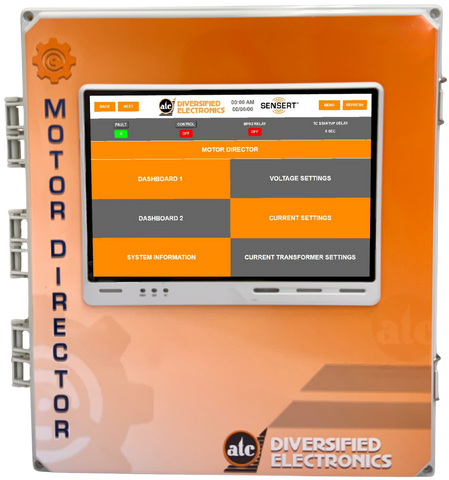
Environmental factors like pump cavitation, air entrainment, or impeller clogging change the mechanical load on the motor. Advanced systems like the Motor Director monitor these load characteristics in real-time, identifying "binding" or "clogging" long before a physical inspection is scheduled.
The Anatomy of a Total Station Failure
The report highlights a sobering case study involving a duplex station with two 40 HP pumps. The sequence of events serves as a warning for every utility manager:
- The Undetected Fault: Pump A began experiencing bearing wear. The current increased slightly but remained below the thermal relay's trip point.
- The Hidden Failure: The pump eventually seized. Because there was no predictive alarm, the utility was unaware they were now running a single-pump station with zero redundancy.
- The Storm: During a heavy rain event, Pump B was forced into continuous duty to handle the surge. Already strained, Pump B overheated and tripped its relay.
- The Overflow: With both pumps offline, the wet well overflowed, leading to environmental contamination.
The Financial Fallout: ~$49,500
The cost of this single event was far higher than a simple pump repair. The breakdown included:
- Pump Replacement & Installation: $24,000
- Emergency Labor & Service: $3,500
- Environmental Cleanup: $12,000
- Regulatory Fines: $10,000
Moving from Reactive to Predictive with Motor Director™
The solution lies in "expanded visibility." Advanced motor protection systems like the Motor Director bridge the gap left by traditional starters.
- Continuous Monitoring: Unlike relays that only act during a fault, these systems analyze power quality and load behavior 24/7.
- SCADA Integration: By feeding data into existing SCADA systems, maintenance teams can receive early-stage alerts weeks before a failure occurs.
- Reliability Standards: Grounding maintenance in IEEE 493-2007 standards ensures that protective devices are actually doing their job, detecting problems before they become outages.
Data is the Best Defense
Wastewater infrastructure is too critical, and the penalties for failure are too high to rely on 20th-century protection methods. Transitioning to a predictive maintenance model doesn't just protect the motors; it protects the budget, the environment, and the community.
Common Questions About Motor Director and Wastewater Lift Station Reliability
Why is redundancy not always enough in a wastewater lift station?
Redundancy helps keep a lift station operating when one pump fails, but it does not always reveal when a pump is silently degrading. If one pump begins to fail without an early warning, the remaining pump may be forced into heavier service, leaving the station with less protection during high-flow events.
How can a duplex lift station lose reliability without anyone noticing?
A duplex lift station can lose reliability when one pump develops a hidden issue such as bearing wear, clogging, binding, or electrical stress. The pump may continue running long enough to avoid a traditional trip, but its performance may decline until the station is effectively operating with limited backup capacity.
How does Motor Director support wastewater lift station reliability?
Motor Director supports wastewater lift station reliability by continuously monitoring motor and pump operating conditions. By tracking voltage, current, power quality, load behavior, and operating trends, it helps maintenance teams identify developing issues before they become pump failures, emergency repairs, or overflow events.
What lift station problems can advanced motor monitoring help identify?
Advanced motor monitoring can help identify conditions such as phase loss, voltage imbalance, undervoltage, abnormal current draw, excessive load, pump binding, impeller clogging, cavitation, bearing wear, and changing motor performance. These early indicators can help maintenance teams investigate problems before a pump is taken offline unexpectedly.
Why are traditional thermal overload relays limited in lift station applications?
Traditional thermal overload relays are important safety devices, but they are generally reactive. They typically respond after current and heat have reached a trip condition. Many pump problems develop gradually at levels below the trip threshold, which means damage can occur before a standard relay responds.
How can Motor Director help reduce the risk of sanitary sewer overflows?
Motor Director can help reduce sanitary sewer overflow risk by giving maintenance teams earlier visibility into pump degradation and abnormal operating conditions. When teams can identify a developing issue before a pump fails, they have more time to schedule service, restore redundancy, and reduce the chance of both pumps being unavailable during a high-flow event.
How does SCADA integration improve lift station maintenance?
SCADA integration allows motor and pump health data to be shared with existing monitoring systems. This gives operators and maintenance teams access to early alerts, trend data, and operating history, helping them respond to developing issues before they become emergency lift station failures.
What is the difference between reactive and predictive lift station maintenance?
Reactive maintenance occurs after a pump trips, fails, or causes a service problem. Predictive maintenance uses operating data and trend monitoring to identify early warning signs before failure occurs. For wastewater lift stations, predictive maintenance helps protect pumps, budgets, regulatory compliance, and the surrounding community.