


PRODUCTS
Solid State Relays
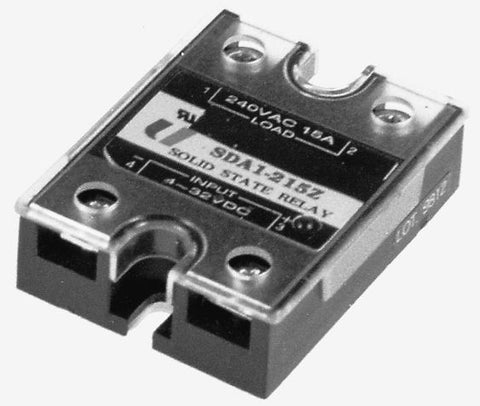
Solid State Relays for Industrial AC Load Switching
ATC Diversified Electronics offers the SA/SD Series Solid-State Relays for industrial applications requiring electronic switching without the moving contacts used in conventional electromechanical relays.
The SA/SD Series is available with DC or AC control inputs and AC load-switching configurations. Published models provide 15, 25, or 40 amp output ratings for compatible 50-240 VAC loads, allowing the relay to be selected according to the control signal and load requirements of the application.
DC-input configurations accept 4-32 VDC control signals, while AC-input configurations accept 85-240 VAC. Selected SD configurations also provide an LED operating indicator. Compatible heat sinks are available for applications requiring appropriate thermal management.
Why Use a Solid State Relay?
A solid state relay, or SSR, performs an electronic switching function in response to an external control voltage. Unlike an electromechanical relay, a solid state relay does not rely on mechanically moving contacts to switch the connected load.
Eliminating mechanical switching components can be useful in applications involving frequent switching cycles or where contact wear associated with conventional mechanical relays is undesirable.
Solid state relays still must be selected according to the electrical characteristics of the application, including control voltage, load voltage, load current, switching requirements, ambient temperature, and thermal management.
SA/SD Series AC and DC Input Solid State Relays
The ATC SA/SD Series provides both AC-input and DC-input solid state relay options so the control side of the relay can be matched to different industrial automation systems.
Available control-input ranges include:
- 4-32 VDC for compatible DC control signals
- 85-240 VAC for compatible AC control signals
This allows the relay family to interface with a variety of compatible industrial controllers, electronic control circuits, and automation equipment.
15A, 25A and 40A Solid State Relay Options
ATC offers SA/SD Series solid state relays with published output-current ratings of 15 amps, 25 amps, and 40 amps.
Standard published output configurations switch compatible 50-240 VAC loads. The required relay should be selected according to the actual load current and the electrical and thermal requirements of the application rather than simply choosing the highest available current rating.
AC Load Switching with Electronic Control
The SA/SD Series separates the control function from the switched AC load. When the appropriate control voltage is applied to the relay input, the solid-state switching circuit changes the state of the connected output.
This makes the relay suitable for compatible industrial applications where a lower-power control signal must electronically switch an AC load.
DC-Controlled Solid State Relays
ATC offers SA/SD Series configurations that accept 4-32 VDC control inputs. These models can be considered where a compatible DC control signal is available from the machine or automation system.
The DC rating refers to the control input. The standard output specifications published for the SA/SD Series are for AC load switching, so a DC-input model should not be interpreted as a DC-output solid state relay.
AC-Controlled Solid State Relays
AC-input configurations are available for 85-240 VAC control signals. These models provide an option for systems where the relay must be actuated directly from a compatible AC control circuit rather than a low-voltage DC signal.
LED Operating Indication
Selected SD Series configurations include an LED operating indicator. The indicator provides a visual reference for the relay's control state during setup, operation, or troubleshooting.
Because the LED feature is model-dependent, it should be confirmed for the exact part number being specified.
Heat Sinks for Solid State Relays
Solid state relays generate heat while switching electrical loads, making thermal management an important part of SSR selection and installation. ATC offers compatible heat sinks for the SA/SD Series.
Heat-sink requirements depend on the selected relay, load current, switching duty, ambient temperature, mounting arrangement, enclosure conditions, and other thermal factors. The applicable product documentation should be reviewed when sizing the relay and heat sink.
Solid State Relays vs. Electromechanical Relays
An electromechanical relay uses a coil and mechanically moving contacts to change the state of a load circuit. A solid state relay performs the switching function electronically and therefore has no mechanically moving switching contacts.
The technologies also have different electrical and thermal characteristics. Solid state relays can exhibit characteristics such as off-state leakage and on-state voltage drop, while electromechanical relays have physical contact wear and mechanical operating characteristics.
The appropriate technology depends on the load, switching frequency, control system, electrical isolation requirements, thermal conditions, failure-mode considerations, and overall machine design.
Industrial Solid State Relay Applications
SA/SD Series solid state relays can be considered for compatible industrial automation, OEM machinery, packaging equipment, processing equipment, material handling systems, control panels, and other electronically controlled AC load-switching applications.
The relay should always be matched to the actual load characteristics. Output current, operating voltage, control voltage, switching duty, temperature, heat sinking, and applicable electrical requirements should be verified before installation.
Choose the Right SA/SD Solid State Relay
Start by identifying whether the available control signal is DC or AC. Then determine the required AC load voltage and current rating.
ATC offers configurations with 4-32 VDC or 85-240 VAC control inputs and published 15A, 25A, and 40A output options for compatible 50-240 VAC loads. Also consider LED indication, heat-sink requirements, ambient temperature, mounting, switching frequency, and the electrical characteristics of the connected load.
Solid State Relay FAQs
What solid state relays does ATC offer?
ATC's current Solid State Relays collection contains the SA/SD Series DC and AC Input Solid-State Relays.
What is a solid state relay?
A solid state relay is an electronic switching device that changes the state of a load circuit when the appropriate electrical signal is applied to its control input. Unlike an electromechanical relay, it does not use mechanically moving switching contacts.
What is the ATC SA/SD Series?
The SA/SD Series is ATC's family of solid state relays with AC or DC control-input options and AC load-switching outputs.
What control voltages are available for the SA/SD Series?
Published configurations include 4-32 VDC control inputs and 85-240 VAC control inputs.
What output voltage does the SA/SD Series support?
ATC lists standard SA/SD Series output configurations for compatible 50-240 VAC loads.
What current ratings are available?
ATC offers SA/SD Series models with published output ratings of 15 amps, 25 amps, and 40 amps.
Does a DC-input solid state relay switch a DC load?
Not necessarily. In the SA/SD Series, the DC specification can refer to the control input. Standard published SA/SD output configurations switch AC loads, so input type and output type should be evaluated separately.
Can the SA/SD Series use an AC control signal?
Yes. ATC offers configurations designed for 85-240 VAC control inputs.
Can the SA/SD Series use a DC control signal?
Yes. ATC offers configurations designed for 4-32 VDC control inputs.
Do ATC solid state relays have an LED indicator?
Selected SD Series models include an LED operating indicator. The feature should be confirmed for the exact model being selected.
Do solid state relays have moving contacts?
No. A solid state relay performs its switching function electronically rather than using mechanically moving switching contacts.
What is the difference between a solid state relay and an electromechanical relay?
An electromechanical relay uses a coil and physical contacts that move when the relay operates. A solid state relay performs the switching function electronically. Each technology has different switching, electrical, thermal, and application characteristics.
Why are solid state relays used for frequent switching?
Because solid state relays do not use mechanical switching contacts, they do not experience mechanical contact wear in the same way as electromechanical relays. The actual relay still must be properly sized for the load, duty cycle, temperature, and thermal conditions.
Do solid state relays generate heat?
Yes. Solid state switching devices dissipate heat during operation, so thermal management must be considered when selecting and installing an SSR.
Does ATC offer heat sinks for the SA/SD Series?
Yes. ATC identifies compatible heat sinks as available for the SA/SD Series.
How do I choose a solid state relay current rating?
Determine the actual load current and load characteristics, then account for switching duty, ambient temperature, heat sinking, enclosure conditions, and any required derating. Select the appropriate relay using the specifications for the exact model.
Can a solid state relay replace any electromechanical relay?
No. The two technologies have different electrical, thermal, leakage, switching, and failure characteristics. Control voltage, load type, current, voltage, switching frequency, thermal management, and system requirements should be reviewed before making a substitution.
Where are solid state relays used?
Solid state relays can be used in compatible industrial automation, OEM machinery, packaging, processing, material handling, machine controls, and other applications where an electronic control signal must switch an AC electrical load.
How do I choose the right ATC SA/SD Series relay?
Determine whether the control signal is AC or DC, then identify the load voltage, load current, switching duty, ambient temperature, thermal requirements, LED-indication preference, and mounting requirements. Compare those requirements with the specifications for the exact SA/SD part number.