


PRODUCTS
1/16 Din Counters
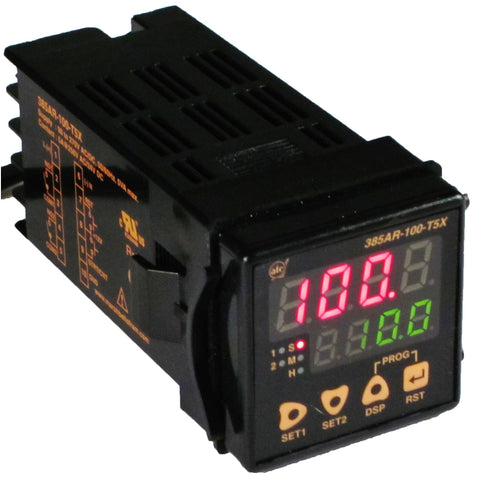
1/16 DIN Counter and Timer/Counter for Industrial Automation
ATC Diversified Electronics offers the 385AR Series 1/16 DIN Timer Counter for industrial applications requiring both programmable timing and electronic counting in a compact panel-mounted control. The 385AR combines 10 operating modes, dual setpoints, programmable input scaling, batch counting, repeat-cycle timing, and up/down counting in a 48 x 48 mm 1/16 DIN housing.
The 385AR accepts voltage-pulse inputs from compatible proximity switches, encoders, solid-state devices, and potential-free contacts, with selectable input speeds up to 5 kHz. A built-in 12 VDC sensor supply can power compatible sensing devices, helping simplify panel wiring in counting and machine-control applications.
Dual 4-digit LED displays, relay-status indicators, front-panel and remote reset options, retained memory, and two SPST normally open relay outputs make the 385AR suitable for packaging, conveyors, material handling, plastics machinery, motor and pump monitoring, production equipment, and industrial process control.
Why Choose the ATC 385AR 1/16 DIN Counter?
Timer and Counter in One Device: The 385AR combines programmable timing and electronic counting so one compact control can support multiple machine and process functions.
10 Operating Modes: Timer modes include ON-delay, interval, cyclic ON-first, cyclic OFF-first, and batch operation. Counter modes include ON-delay, interval, auto reset, timed pulse repeat, and batch operation.
Dual Setpoints: Two programmable setpoints allow the controller to perform staged or multi-step timed and counted control sequences.
High-Speed Counting: Selectable input speeds of 3 Hz, 30 Hz, and 5 kHz allow the counter to work with both slower contact inputs and faster compatible electronic pulse sources.
Programmable Input Scaling: Adjustable scaling allows incoming pulses to be converted into a more useful displayed or controlled value for the application.
Batch Counting: Batch operation allows the 385AR to control grouped quantities or repeated production sequences based on programmed count values.
Up/Down Counting: The counter can be configured for upward or downward count operation, depending on the required process.
Built-In Sensor Supply: A short-circuit-protected 12 VDC, 30 mA sensor supply is built into the 385AR for compatible sensors.
Universal Supply Voltage: The standard 385AR operates from 85 to 270 VAC/DC at 50/60 Hz.
Protected Front Face: ATC specifies an IP65 protection level for the front face of the 385AR.
High-Speed Industrial Counting
The 385AR industrial counter supports selectable input speeds of 3 Hz, 30 Hz, and 5 kHz. This allows the same controller to be configured for slower electromechanical inputs or faster signals from compatible proximity switches, encoders, and solid-state devices.
ATC specifies counter accuracy at ±0 counts, meaning accepted count pulses are accumulated without a timing-based count tolerance when the input signal meets the published electrical and frequency requirements.
Programmable Scaling and Batch Counting
The 385AR provides a programmable scale factor beginning at 0.001 to 9.999 with selectable decimal scaling multipliers. This allows raw input pulses to be translated into a useful displayed quantity when one pulse does not directly represent one final unit.
Batch-counting capability allows the controller to organize individual counts into larger production or process quantities. This can be useful in packaging, material handling, production machinery, and other applications where a control action is required after a programmed number of events.
Dual Setpoints and Relay Outputs
The 385AR provides two setpoints and two SPST normally open relay outputs. Each relay is rated up to 5 amps at 230 VAC for compatible loads.
Dual setpoints allow separate output actions to be programmed within a timing or counting sequence, providing more flexibility than a single-setpoint counter.
Timer and Repeat-Cycle Functions
In addition to counting, the 385AR operates as a multifunction timer. Available timer modes include ON-delay, interval, cyclic ON-first, cyclic OFF-first, and batch.
Timer accuracy is specified at ±0.05% of the selected setting. The unit can count time downward and provides LED indication for seconds, minutes, hours, Relay 1, and Relay 2.
Count Inputs for Sensors and Encoders
The 385AR accepts 3 to 30 VDC pulse inputs from compatible sensing and control devices. ATC identifies proximity switches, solid-state devices, potential-free contacts, and encoders as suitable input sources.
The built-in 12 VDC sensor supply can provide up to 30 mA for compatible sensors, reducing the need for a separate low-voltage power supply in some control-panel applications.
Reset and Memory Functions
The 385AR supports reset from the front panel, a remote input, or a power interruption, depending on the operating configuration.
Memory retention allows programmed information to be preserved according to the selected operating setup, helping maintain settings when equipment power is cycled.
Compact 1/16 DIN Panel Mounting
The 385AR uses a compact 48 x 48 mm 1/16 DIN panel format, making it suitable for OEM equipment and high-density industrial control panels where available panel space is limited.
Its IP65-rated faceplate provides additional protection at the front of the installed controller, while rear screw-terminal connections support direct panel wiring.
Applications for the 385AR Timer Counter
ATC identifies applications including OEM equipment, packaging, plastics manufacturing, machinery monitoring and control, material handling, conveyors, motor, compressor and pump monitoring, and industrial process control.
The combination of timer, counter, scaling, batch, sensor-input, and repeat-cycle capabilities makes the 385AR particularly useful where several control functions must fit within one compact panel position.
Find the Right 385AR Counter Configuration
Selecting the right 1/16 DIN timer counter requires consideration of the desired timer or counter mode, maximum pulse frequency, count direction, sensor type, scaling requirements, setpoints, relay loads, reset method, supply voltage, and batch or repeat-cycle requirements.
Explore the ATC 385AR Series above for compact multifunction timing and counting control in industrial automation, machine monitoring, packaging, production, and material-handling applications.
1/16 DIN Counter FAQs
What 1/16 DIN counter does ATC offer?
ATC's current 1/16 DIN Counters collection contains the 385AR Series 1/16 DIN Timer Counter.
What is the ATC 385AR Timer Counter?
The 385AR is a multifunction 1/16 DIN timer and counter that combines timing, counting, repeat-cycle, batch, scaling, dual-setpoint, and up/down-counting functions in one compact panel-mounted controller.
How many operating modes does the 385AR provide?
The 385AR provides 10 operating modes in total, with five timer modes and five counter modes.
What timer modes does the 385AR provide?
Timer modes include ON-delay, interval, cyclic ON-first, cyclic OFF-first, and batch operation.
What counter modes does the 385AR provide?
Counter modes include ON-delay, interval, auto reset, timed pulse repeat, and batch operation.
How fast can the 385AR count?
The 385AR provides selectable input speeds of 3 Hz, 30 Hz, and 5 kHz, allowing operation with both slower contacts and compatible high-speed electronic pulse sources.
What type of count inputs does the 385AR accept?
The 385AR accepts 3 to 30 VDC pulse inputs from compatible proximity switches, solid-state devices, potential-free contacts, and encoders.
Can the 385AR count up and down?
Yes. Counter operation supports both up and down counting.
Does the 385AR support batch counting?
Yes. Batch counting is one of the available operating functions and can be used to control grouped production or process quantities.
Does the 385AR provide programmable input scaling?
Yes. The 385AR provides programmable input scaling so incoming pulse counts can be converted into a useful displayed or controlled quantity.
What scale factor does the 385AR provide?
ATC specifies a programmable base scale factor from 0.001 to 9.999 with selectable decimal multipliers for additional scaling flexibility.
How many setpoints does the 385AR have?
The 385AR provides two programmable setpoints.
What outputs does the 385AR provide?
The 385AR provides two SPST normally open relay outputs rated up to 5 amps at 230 VAC for compatible loads.
Does the 385AR include a sensor power supply?
Yes. The 385AR includes a built-in 12 VDC, 30 mA sensor supply with short-circuit protection for compatible sensors.
What display does the 385AR use?
The 385AR uses dual 4-digit, 7-segment LED displays along with status indicators for Relay 1, Relay 2, seconds, minutes, and hours.
How accurate is the 385AR?
ATC specifies timer accuracy of ±0.05% of setting and counter accuracy of ±0 counts when the input signal meets the published specifications.
How can the 385AR be reset?
The 385AR supports front-panel reset, remote reset, and reset through power interruption according to the selected configuration.
What supply voltage does the 385AR use?
The standard 385AR operates from 85 to 270 VAC/DC at 50/60 Hz. ATC also notes that a 24 VAC/DC version is available by consulting the factory.
Is the 385AR faceplate protected against dust and water?
ATC specifies an IP65 protection level for the front face of the 385AR. The complete installation must still follow the applicable enclosure and wiring requirements.
Is the 385AR UL approved and CE certified?
Yes. ATC identifies the 385AR as UL approved and CE certified.
What size is the 385AR?
The 385AR uses a compact 1/16 DIN 48 x 48 mm panel format with a mounting depth of approximately 46 mm according to ATC's published product information.
Where is the 385AR used?
Applications include OEM equipment, packaging, plastics manufacturing, machinery monitoring and control, material handling, conveyor control, motor, compressor and pump monitoring, and industrial process control.
How do I choose the right 385AR setup?
Determine whether timer or counter operation is required, then consider operating mode, input speed, pulse source, count direction, scaling, setpoints, batch requirements, relay loads, reset method, supply voltage, and sensor-power requirements.