


PRODUCTS
TC/PID Controller
PID Temperature Controllers for Precise Industrial Process Control
ATC Diversified Electronics offers a range of PID temperature controllers designed for accurate and repeatable temperature regulation in industrial equipment, OEM machinery, heating processes, and automated systems. Available controllers include the 500 Series, ATC550, and ATC560, providing multiple levels of control capability for applications ranging from straightforward temperature regulation to more advanced process control.
ATC temperature controllers support thermocouple and RTD temperature inputs, PID and ON/OFF control, dual digital displays, and selectable Celsius or Fahrenheit operation. Depending on the model, additional capabilities include auto-tuning, multiple setpoints, relay or SSR outputs, analog inputs, heat/cool control, ramp-soak programming, soft start, and RS485 communication.
Compact 1/16 DIN temperature controller housings make these products well suited for control panels, process equipment, ovens, plastics machinery, environmental systems, and other temperature-critical applications where panel space and dependable regulation are important.
Why Choose ATC PID Temperature Controllers?
PID and ON/OFF Control: ATC temperature controllers support PID control for applications requiring tighter process regulation, while ON/OFF control provides a straightforward option for less complex heating or cooling applications.
Thermocouple and RTD Inputs: Available controllers accept common thermocouple and RTD temperature sensors, allowing the controller to be matched to a wide range of process-temperature measurement requirements.
PID Auto-Tuning: Selected models can automatically calculate PID parameters based on the response of the process, helping simplify controller setup and improve temperature stability.
Relay and SSR Output Options: Depending on the model, control outputs can be configured for relay or solid-state relay drive to support different heaters, contactors, and industrial control devices.
Dual Digital Displays: Dual 4-digit LED displays provide clear process and setpoint information, helping operators monitor and adjust temperature-control systems.
Compact 1/16 DIN Design: The 48 x 48 mm panel format provides advanced temperature-control capability while conserving space in industrial control panels and OEM equipment.
Advanced PID Temperature Control Options
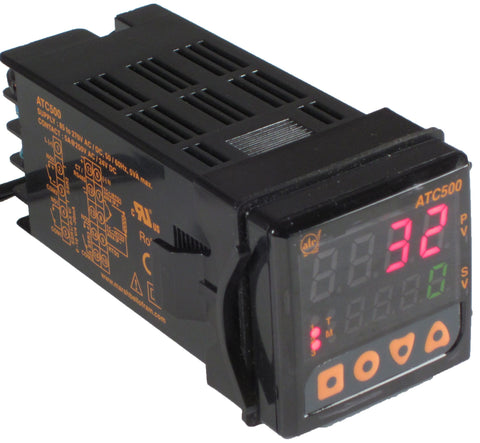
The 500 Series TC PID Temperature Controller provides the broadest feature set in the collection, including selectable thermocouple, RTD, current, and voltage inputs. It supports PID, PID auto-tune, ON/OFF, heat/cool PID control, ramp-soak programming, soft start, multiple output types, and RS485 communication.
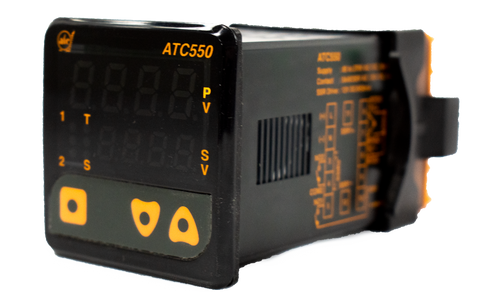
The ATC550 TC/PID Controller provides thermocouple and RTD input, PID and ON/OFF control, two setpoints, selectable Celsius or Fahrenheit display, field-selectable relay or SSR control output, and an auxiliary output in a compact 1/16 DIN package.
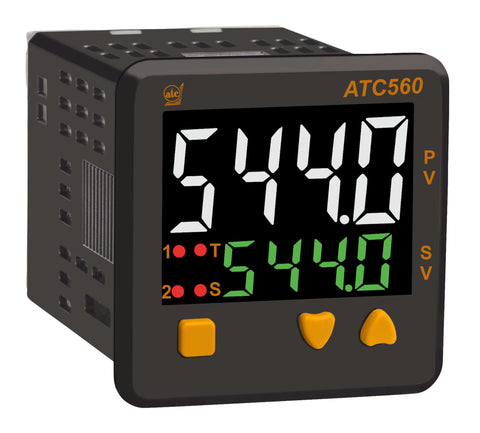
The ATC560 Temperature Controller combines thermocouple and RTD inputs with PID and ON/OFF control, two setpoints, auto/self-tuning, selectable relay or SSR control output, an auxiliary relay output, and a dual 4-digit display for straightforward industrial temperature management.
PID Temperature Controller Applications
ATC PID temperature controllers are suited for temperature-control applications including commercial ovens, cooking equipment, plastics processing and extrusion zones, heat-treating and curing equipment, environmental chambers, greenhouse systems, industrial heating equipment, and other processes where maintaining a controlled temperature is important.
Find the Right PID Temperature Controller
Selecting the right PID temperature controller depends on sensor type, temperature range, control method, number of setpoints, output type, heating and cooling requirements, communication needs, programming requirements, supply voltage, and available panel space.
Explore the ATC TC/PID controllers above to compare sensor inputs, control modes, outputs, tuning features, and advanced process-control capabilities. ATC Diversified Electronics can also assist with selecting a temperature controller for OEM machinery, industrial automation, plastics processing, heating equipment, and other temperature-control applications.
PID Temperature Controller FAQs
What is a PID temperature controller?
A PID temperature controller monitors process temperature and adjusts a heating or cooling output to maintain a selected setpoint. PID stands for proportional, integral, and derivative, the three control actions used to respond to the difference between measured temperature and the desired setpoint.
What is the difference between PID and ON/OFF temperature control?
ON/OFF control switches the output fully on or off when temperature moves around the setpoint. PID control continuously evaluates process behavior and adjusts the control response to provide tighter and more stable temperature regulation when the application requires it.
What temperature sensors can ATC PID controllers use?
ATC PID temperature controllers support thermocouple and RTD inputs. The 500 Series also provides selectable analog current and voltage inputs, giving it additional flexibility for process-control applications.
What is PID auto-tuning?
PID auto-tuning allows a controller to evaluate how the process responds to changes in output and automatically calculate suitable PID control parameters. This can simplify setup compared with manually determining proportional, integral, and derivative settings.
What is a 1/16 DIN temperature controller?
A 1/16 DIN controller uses a standardized compact panel format measuring approximately 48 x 48 mm. This size is commonly used in industrial control panels because it provides process-control functionality in a relatively small panel footprint.
What features does the ATC 500 Series PID Temperature Controller provide?
The 500 Series includes thermocouple, RTD, current, and voltage input options along with PID, PID auto-tune, ON/OFF control, heat/cool PID, ramp-soak programming, soft start, selectable Celsius or Fahrenheit display, multiple output options, and RS485 communication.
What features does the ATC550 TC/PID Controller provide?
The ATC550 provides thermocouple and RTD input, PID and ON/OFF control, two setpoints, Celsius or Fahrenheit selection, a dual 4-digit LED display, field-selectable relay or SSR control output, and an auxiliary relay or SSR output depending on the selected configuration.
What features does the ATC560 Temperature Controller provide?
The ATC560 provides thermocouple and RTD input, PID and ON/OFF control, two setpoints, auto/self-tuning, selectable Celsius or Fahrenheit display, relay or SSR control output, an auxiliary relay output, and dual 4-digit LED displays.
What is heat/cool PID control?
Heat/cool PID control allows a temperature controller to manage both heating and cooling outputs around the same process setpoint. The 500 Series supports heat/cool PID for applications that require active heating as well as cooling.
What is ramp-soak temperature control?
Ramp-soak control changes temperature according to a programmed profile. A ramp gradually moves the process toward a target temperature, while a soak holds that temperature for a defined period. The ATC 500 Series includes ramp-soak capability for processes requiring staged temperature control.
Does ATC offer PID controllers with RS485 communication?
Yes. The ATC 500 Series includes RS485 communication, allowing compatible automation or supervisory systems to communicate with the temperature controller.
What applications use PID temperature controllers?
PID temperature controllers are used in applications such as commercial ovens, plastics processing and extrusion, heat treating, curing equipment, environmental chambers, greenhouse climate control, industrial heating, and other processes requiring controlled temperature.
How do I choose the right PID temperature controller?
Consider the temperature sensor type, required temperature range, PID or ON/OFF control needs, number of setpoints, relay or SSR output requirements, heat/cool capability, auto-tuning needs, communication requirements, programming features, supply voltage, and panel size.