


PRODUCTS
Liquid Level Control
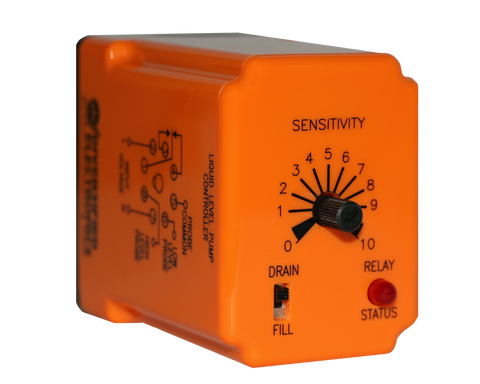
Liquid Level Controllers for Pump Up and Pump Down Applications
ATC Diversified Electronics offers the LPC Series Liquid Level Pump Controller for automatic liquid-level control in tanks, sumps, reservoirs, water systems, wastewater equipment, and other applications using conductive liquids. The controller uses separate high- and low-level probes to determine when its output relay should energize or de-energize.
The LPC Series provides user-selectable Fill (Pump Up) and Drain (Pump Down) operation. In Drain mode, the relay energizes when liquid reaches the high-level probe and de-energizes after the level falls below the low-level probe. In Fill mode, the sequence is reversed so the relay energizes when liquid falls below the low-level probe and de-energizes when the high-level probe is reached.
Adjustable probe sensitivity allows the controller to accommodate a range of conductive liquids, while an SPDT relay output provides a control signal for compatible pump starters, contactors, alarms, or other control equipment. LED indication shows when the LPC output relay is active.
Why Choose the LPC Series Liquid Level Controller?
Fill or Drain Operation: A user-selectable operating mode allows the same controller to be configured for tank filling or tank draining applications.
Two-Level Control: Separate high- and low-level probes establish the operating range between pump start and stop points.
Adjustable Conductivity Sensitivity: Probe sensitivity is adjustable from approximately 1 kΩ to 100 kΩ, allowing the controller to be matched to different conductive liquids and sensing conditions.
Low-Energy Probe Circuit: The probe terminals use a pulsed 5 VDC sensing signal for liquid-level detection.
Relay Output: The LPC provides one SPDT relay rated 5 amps resistive at 240 VAC for interface with compatible pump or control circuits.
Visual Relay Indication: A red LED illuminates when the LPC output relay is active, providing a straightforward indication of controller status.
Multiple Supply Voltages: LPC configurations are available for 24 VAC, 120 VAC, and 240 VAC supply power.
Plug-In Construction: The controller uses an 8-pin octal header and Style A plug-in enclosure for convenient control-panel installation and replacement.
Drain Mode for Pump-Down Liquid Level Control
In Drain or Pump Down mode, the LPC relay energizes when liquid rises to the high-level probe. The connected control circuit can then start a compatible pump or other device used to lower the liquid level.
The output remains active until the liquid level falls below the low-level probe. At that point, the relay de-energizes and the LED turns off. Using separate high and low probes establishes a defined operating band rather than switching the pump at a single liquid level.
Fill Mode for Pump-Up Liquid Level Control
In Fill or Pump Up mode, the LPC relay energizes when the liquid level falls below the low-level probe. The output can be used to call for a compatible pump, valve, or control device to replenish the vessel.
When the liquid reaches the high-level probe, the LPC output relay de-energizes and the LED turns off, completing the fill cycle.
Conductive Probes for Liquid Level Sensing
The LPC Series requires compatible conductive probes unless suitable probes are already installed. ATC offers the CPR Series Conductive Probes with a 316 stainless steel sensing tip and PVC cable.
CPR probes are ordered separately from the LPC controller and are available with multiple cable lengths. Probe selection and installation should account for the conductivity of the liquid, tank arrangement, mounting location, and environmental conditions.
Liquid Level Control for Water and Pumping Systems
Conductive liquid-level control can be used in tanks, sumps, reservoirs, water-transfer systems, pump stations, wastewater equipment, process vessels, and other applications where a conductive liquid must be maintained between defined high and low levels.
Because the LPC relies on electrical conductivity between its probes and common connection, it should be applied to liquids and installations that are compatible with conductive level-sensing technology.
Find the Right LPC Liquid Level Controller
Selecting the right liquid level control relay depends on whether the process requires Fill or Drain operation, supply voltage, liquid conductivity, probe placement, relay-load requirements, pump-control architecture, environmental conditions, and compatibility with the selected conductive probes.
Explore the LPC Series above to select the appropriate 24 VAC, 120 VAC, or 240 VAC configuration, and pair it with compatible CPR Series probes or another suitable conductive probe system.
Liquid Level Control FAQs
What is a liquid level controller?
A liquid level controller monitors the level of liquid in a tank, reservoir, sump, or vessel and changes an electrical output when defined level conditions are reached. The ATC LPC Series uses conductive probes to control its output relay between high- and low-level setpoints.
What is the ATC LPC Series Liquid Level Pump Controller?
The LPC Series is a conductive liquid-level controller that uses separate high- and low-level probes to sense liquid level. It can be configured for either Fill (Pump Up) or Drain (Pump Down) operation.
How does Drain or Pump Down mode work?
In Drain mode, the LPC output relay energizes and its LED turns on when liquid reaches the high-level probe. The relay remains energized until the liquid falls below the low-level probe, at which point the relay and LED turn off.
How does Fill or Pump Up mode work?
In Fill mode, the LPC output relay energizes and its LED turns on when the liquid level falls below the low-level probe. The relay remains energized until the liquid reaches the high-level probe, at which point the relay and LED turn off.
How many probes does the LPC Series use?
The LPC Series uses a high-level probe, a low-level probe, and a common probe connection to establish the liquid-level control points.
Does the LPC Series include the conductive probes?
No. ATC states that the conductive probes must be ordered separately unless compatible probes are already available in the application. ATC offers the CPR Series Conductive Probes for use with the LPC.
What are CPR Series Conductive Probes?
CPR Series probes are liquid-level sensing probes offered for use with the LPC controller. They use a 316 stainless steel sensing tip and PVC cable and are available with multiple cable lengths.
What liquids can a conductive level controller detect?
A conductive level controller requires enough electrical conductivity through the liquid for the sensing circuit to detect the probe condition. Compatibility depends on the liquid conductivity, probe arrangement, and sensitivity setting.
Can the LPC Series be used with non-conductive liquids?
The LPC is designed for conductive liquid-level sensing. Liquids with insufficient conductivity may not provide a reliable sensing path, so another level-sensing technology may be required.
Is the LPC probe sensitivity adjustable?
Yes. ATC specifies adjustable sensitivity from approximately 1 kΩ at the low end to 100 kΩ at the high end.
What voltage is applied to the LPC sensing probes?
The LPC uses a pulsed 5 VDC sensing signal at the probe terminals.
What output does the LPC Series provide?
The LPC provides one SPDT relay output rated 5 amps resistive at 240 VAC.
What supply voltages are available for the LPC Series?
The LPC Series is available in 24 VAC, 120 VAC, and 240 VAC supply configurations.
Does the LPC Series provide a status indicator?
Yes. A red LED illuminates whenever the LPC output relay is active.
How is the LPC Series mounted?
The LPC uses a Style A plug-in enclosure with an 8-pin octal header. ATC also lists Panel Mount Bracket A as an accessory for the Style A housing.
Is the LPC Series UL approved?
ATC identifies the LPC Series as cULus recognized under file E55826. The exact product markings and documentation should be reviewed when approval is required for a specific installation.
What temperature range does the LPC Series support?
ATC specifies an operating temperature range of -20°C to +60°C and a storage temperature range of -40°C to +80°C.
Where are liquid level controllers used?
Conductive liquid-level controllers can be used in tanks, sumps, reservoirs, water-transfer systems, pump stations, wastewater equipment, process vessels, and other applications where a conductive liquid must be controlled between defined high and low levels.
How do I choose the right LPC configuration?
Determine whether Fill or Drain operation is required, then confirm the supply voltage, liquid conductivity, probe material and placement, relay-load requirements, mounting arrangement, and compatibility with the pump or control circuit.