


PRODUCTS
Motor Auto-Restart Relay
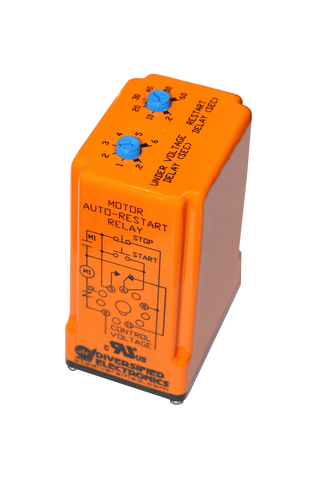
Motor Auto-Restart Relay for Controlled Restart After Momentary Power Loss
The ATC Diversified Electronics MAR Series Motor Auto-Restart Relay provides controlled automatic restart of a motor following a momentary drop or interruption of the 120 VAC control voltage. When the motor was operating before the voltage disturbance and acceptable control voltage returns within the configured undervoltage time, the MAR Series can bypass the START switch and re-energize the motor starter coil after an adjustable restart delay.
The relay is designed for applications where a brief control-power interruption would otherwise require an operator to manually restart equipment. Adjustable undervoltage and restart delays allow the control sequence to be matched to the application and can be used to stagger the restart of multiple motors rather than allowing all equipment to re-energize simultaneously.
The MAR Series also distinguishes between a qualifying control-voltage interruption and an intentional STOP pushbutton operation. If the STOP circuit is operated, the automatic-restart timing sequence is terminated. If the voltage interruption lasts longer than the selected undervoltage delay, or if the motor was not running when the voltage failed, manual restart is required.
Why Use the MAR Series Motor Auto-Restart Relay?
Automatic Restart After Brief Voltage Interruptions: The MAR Series can restore a previously running motor after a qualifying momentary control-voltage disturbance without requiring an operator to press the START button.
Adjustable Undervoltage Timing: Depending on the selected configuration, the undervoltage delay can be adjustable from 0.2 to 6 seconds or 0.2 to 10 seconds, with another configuration providing a fixed 4-second delay.
Adjustable Restart Delay: Available configurations provide restart-delay adjustment from 0.2 to 60 seconds or from 2 to 120 seconds, allowing motor restarts to be delayed after acceptable control voltage returns.
Stagger Multiple Motor Restarts: Different restart-delay settings can be used on multiple motors so their starter coils are not commanded to re-energize at the same instant following restoration of control power.
Distinguishes STOP Commands from Power Loss: Operating the STOP pushbutton de-energizes the MAR output and terminates the timing sequence, preventing an intentional stop from being treated as a momentary power failure.
Plug-In Configurations: The MAR Series is available in 8-pin and 11-pin plug-in models, including versions with an overload-relay L2 disconnect feature.
Industrial Relay Output: The MAR Series provides an SPDT output relay rated Pilot Duty B150, 360 VA, and 10 amps at 120 VAC resistive.
How the MAR Motor Auto-Restart Sequence Works
While the motor is running, the MAR Series monitors the 120 VAC control voltage. If that voltage drops below the undervoltage trip point, the undervoltage timing period begins.
If control voltage rises above the restart-voltage threshold before the undervoltage delay expires, the MAR Series begins its adjustable restart delay. When the restart delay is complete, the internal relay energizes for the specified output interval to provide the motor restart command.
If control voltage remains below the required level longer than the undervoltage delay, the MAR Series does not automatically restart the motor when power returns. Manual restart is required. The same is true if the motor was not operating before the control-voltage interruption.
Undervoltage and Restart Voltage Monitoring
The MAR Series monitors a 120 VAC, 50/60 Hz control circuit. ATC specifies a factory-preset undervoltage trip point of approximately 92 VAC, internally adjustable from 70 to 100 VAC.
The factory-preset restart-voltage point is approximately 102 VAC and is established approximately 10 VAC above the selected undervoltage point. This separation helps define when the control voltage has recovered sufficiently for the restart-delay sequence to begin.
Available MAR Restart Timing Configurations
ATC offers multiple MAR delay configurations to support different restart requirements. Depending on part number, available combinations include adjustable undervoltage delays from 0.2 to 6 seconds or 0.2 to 10 seconds, restart delays from 0.2 to 60 seconds, or a fixed 4-second undervoltage delay with a 2 to 120 second restart delay.
Restart-output intervals are available as continuous, fixed 5-second, or fixed 1-second outputs depending on the selected model configuration.
Motor Restart Control for Industrial Equipment
Motor auto-restart control can be useful on industrial equipment where a short control-power interruption can stop a process even though normal power returns almost immediately. Applications can include pumps, conveyors, processing machinery, material-handling systems, mixers, fans, and other motor-driven equipment where automatic reacceleration is appropriate for the machine and process.
Automatic restart should only be used where restarting without direct operator action is appropriate for the equipment and application. Machine safety requirements, interlocks, overload protection, emergency-stop circuits, process conditions, and applicable electrical requirements must all be considered as part of the overall control-system design.
Find the Right MAR Motor Auto-Restart Relay
Selecting the right motor auto-restart relay configuration depends on the required undervoltage delay, restart delay, restart-output duration, 8-pin or 11-pin termination, overload-relay interface requirements, starter-control circuit, and the operating sequence required by the machine.
Explore the MAR Series above to compare plug-in and delay configurations for controlled motor restart following qualifying momentary control-voltage interruptions.
Motor Auto-Restart Relay FAQs
What is a motor auto-restart relay?
A motor auto-restart relay is a control device that can initiate a motor restart after a qualifying temporary loss or reduction of control voltage. The ATC MAR Series bypasses the START switch to re-energize the motor starter coil after the required voltage and timing conditions are met.
What does the ATC MAR Series Motor Auto-Restart Relay do?
The MAR Series monitors 120 VAC control voltage and can automatically restart a motor that was running before a momentary voltage interruption. If voltage recovers within the selected undervoltage time, the MAR begins its restart delay and then operates its output relay to provide the restart command.
Does the MAR Series restart a motor after every power outage?
No. The motor must have been running when the control-voltage interruption occurred, and acceptable voltage must return before the undervoltage delay expires. If the interruption lasts too long, manual restart is required.
Will the MAR Series automatically restart a motor after the STOP button is pressed?
No. The MAR Series distinguishes a STOP pushbutton operation from a control-voltage failure. Operating the STOP pushbutton de-energizes the output relay and terminates the automatic-restart timing sequence.
What control voltage does the MAR Series monitor?
The MAR Series is designed to monitor 120 VAC, 50/60 Hz control voltage.
What is the MAR Series undervoltage trip point?
ATC specifies a factory-preset undervoltage trip point of approximately 92 VAC. The undervoltage point is internally adjustable from approximately 70 to 100 VAC.
What is the MAR Series restart-voltage point?
ATC specifies a factory-preset restart-voltage point of approximately 102 VAC. The restart point is approximately 10 VAC above the selected undervoltage threshold.
What undervoltage delay ranges are available?
Depending on configuration, the MAR Series provides an adjustable undervoltage delay of 0.2 to 6 seconds, an adjustable range of 0.2 to 10 seconds, or a fixed 4-second undervoltage delay.
What restart-delay ranges are available?
Depending on model configuration, the MAR Series provides an adjustable restart delay of 0.2 to 60 seconds or 2 to 120 seconds.
Can the MAR Series stagger the restart of multiple motors?
Yes. Separate MAR relays can be configured with different restart-delay settings so motors receive their restart commands at different times after acceptable control voltage returns.
How long does the MAR Series output remain energized during restart?
The restart-output duration depends on the selected configuration. Available output intervals include continuous operation, a fixed 5-second interval, or a fixed 1-second interval.
What output relay does the MAR Series use?
The MAR Series provides an SPDT output relay rated Pilot Duty B150, 360 VA, and 10 amps at 120 VAC resistive.
Is the MAR Series available in plug-in configurations?
Yes. ATC offers 8-pin and 11-pin plug-in MAR models. Versions are also available with an overload-relay L2 disconnect feature.
What is the overload-relay L2 disconnect option?
Selected 8-pin and 11-pin MAR configurations provide an L2 disconnect interface for the motor overload relay. The exact wiring arrangement must follow the ATC wiring diagram for the selected model.
What operating temperature does the MAR Series support?
ATC specifies an operating temperature range of 0°C to 55°C and a storage temperature range of -45°C to 85°C.
Where is a motor auto-restart relay used?
Motor auto-restart relays can be used with compatible pumps, conveyors, processing machinery, material-handling systems, mixers, fans, and other motor-driven equipment where controlled automatic restart after a brief control-voltage interruption is appropriate.
Is automatic motor restart appropriate for every motor application?
No. Automatic restart should only be applied where restarting without direct operator action is appropriate for the equipment and process. Safety interlocks, emergency-stop functions, overload protection, personnel hazards, process conditions, and applicable electrical requirements must be considered.
How do I choose the right MAR Series configuration?
Consider the required undervoltage delay, restart delay, restart-output duration, 8-pin or 11-pin connection, overload-relay interface, motor starter circuit, and whether automatic restart is appropriate for the machine and process.