Articles/Case Studies
Difference Between On-Delay and Off-Delay Timers
Difference Between On-Delay and Off-Delay Timers
Understanding the difference between an on-delay and off-delay timer is essential when designing or troubleshooting industrial control systems. While both are time-delay functions, they control when an output turns on or off in very different ways.
This guide explains each timer type in plain terms, shows how they behave, and outlines where each is commonly used in real applications.
What Is an On-Delay Timer?
An on-delay timer, also called a delay-on-make timer, delays turning the output on after an input signal is applied.
How an on-delay timer works (Diagram below)
- Voltage mains turn on
- Timing begins
- Output turns on after the preset time
- When the voltage mains turn off, the output turns off immediately
- Timer reset occurs from cycling voltage mains

Common on-delay timer applications
- Staggered motor starting
- Preventing equipment from starting immediately at power-up
- Allowing sensors or systems to stabilize before operation
- Sequencing loads in control panels
What Is an Off-Delay Timer?
An off-delay timer, also known as a delay-on-break timer, delays turning the output off after the control input signal is removed.
How an off-delay timer works (Diagram below)
- Voltage mains turn on
- Output remains off
- Control input signal turns on, output turns on
- Control input signal turns off
- Timing begins
- Output turns off after the preset time
- Timer reset occurs upon the return of the control input signal

Common off-delay timer applications
- Exhaust or purge fans
- Conveyor run-out timing
- Lighting control
- Equipment cooldown cycles
- Preventing abrupt shutdowns
Why Both Timer Types Matter in Industrial Control
On-delay and off-delay timers are foundational building blocks in automation. They help protect equipment, improve process consistency, and prevent unnecessary wear by controlling timing sequences intentionally rather than relying on operator reaction or instantaneous switching.
Industrial Timers That Support Both Functions
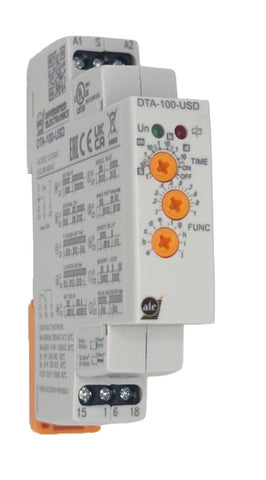
Modern industrial time-delay relays are often designed to support multiple timing modes, allowing engineers to select on-delay or off-delay behavior using configuration settings rather than separate hardware.
Final Takeaway
The difference between an on-delay and an off-delay timer comes down to when the delay occurs. On-delay timers wait before turning on. Off-delay timers wait before turning off. Understanding this distinction ensures proper sequencing, safer operation, and more reliable control systems.
If you are evaluating timing behavior for a control application, selecting the correct delay function is just as important as selecting the timer itself.
Common Questions About On-Delay and Off-Delay Timers
What is the difference between an on-delay timer and an off-delay timer?
The difference comes down to when the delay occurs. An on-delay timer waits before turning the output on after power or an input signal is applied. An off-delay timer keeps the output on for a set amount of time after the control signal is removed, then turns the output off.
What is an on-delay timer?
An on-delay timer, also called a delay-on-make timer, delays output activation after voltage or an input signal is applied. Once the preset time expires, the output turns on. When power is removed, the output turns off immediately and the timer resets.
What is an off-delay timer?
An off-delay timer, also called a delay-on-break timer, delays output deactivation after the control input signal is removed. The output remains on during the preset timing period, then turns off once the delay is complete.
When should I use an on-delay timer?
An on-delay timer is useful when equipment should not start immediately after power is applied. Common uses include staggered motor starting, control panel sequencing, allowing sensors to stabilize, and preventing equipment from energizing too quickly at startup.
When should I use an off-delay timer?
An off-delay timer is useful when equipment needs to keep running briefly after the control signal is removed. Common uses include exhaust fans, purge fans, conveyor run-out timing, lighting control, cooldown cycles, and preventing abrupt shutdowns.
What does delay-on-make mean?
Delay-on-make is another term for on-delay timing. It means the timer delays making or closing the output contact after the input signal or power is applied. The output does not energize until the preset time has expired.
What does delay-on-break mean?
Delay-on-break is another term for off-delay timing. It means the timer delays breaking or opening the output contact after the control input signal is removed. The output remains energized during the preset delay period.
Can one timer support both on-delay and off-delay functions?
Yes. Many modern multifunction time-delay relays support multiple timing modes, including on-delay and off-delay. This allows engineers and maintenance teams to select the required timing behavior through configuration settings instead of using separate timer models for each function.