Articles/Case Studies
Enhancing Motor Reliability Through Vibration Monitoring
Why Vibration Monitoring Matters and How Smart Protection Systems Like ATC Diversified’s Motor Director™ Can Help
Electric motors are the workhorses of modern industry pumping water, driving conveyors, powering compressors, and more. While electrical faults draw obvious attention, mechanical degradation often begins quietly, through vibration changes that precede catastrophic failure by weeks or months. This white paper explains why vibration monitoring is essential to motor asset management and how advanced systems like the ATC Diversified Motor Director™ Advanced Motor Protection System not only collect vibration data but turn it into predictive insights that prevent downtime, extend motor life, and lower maintenance costs.
Electric motor failure costs industry billions annually in downtime, lost productivity, and wasted energy. Traditional protective devices react only after faults occur which means the root causes of mechanical deterioration often go unnoticed until failure happens.
In contrast, vibration monitoring, when combined with electrical and thermal data, offers early detection of mechanical issues like imbalance, misalignment, looseness, and bearing degradation. By detecting subtle vibration trends before they escalate, technicians can schedule maintenance intelligently rather than reactively.
The ISO 10816-3:2009 standard provides an internationally accepted framework for assessing machine vibration, and classifying vibration severity into actionable zones is critical for modern predictive maintenance. This standard emphasizes both absolute severity limits and relative changes in vibration over time as triggers for investigation. (Based on ISO 10816-3 concepts.)
The Case for Vibration Monitoring in Motors
Early Warning of Mechanical Degradation
Electric motors rarely fail instantly. Mechanical faults such as bearing wear or rotor imbalance, manifest as changes in vibration signatures long before they affect electrical performance. According to industrial vibration severity criteria like ISO 10816-3:
- Absolute vibration levels above accepted thresholds signal significant mechanical stress.
- Relative changes (e.g., an increase in RMS vibration of more than 25% from baseline) often indicate early fault development even when absolute values are still within acceptable limits.
These indicators help maintenance teams detect problems early, plan interventions, and avoid unexpected machine shutdowns. Trends matter as much or more than single readings. This is the heart of predictive maintenance philosophy.
Integrating Vibration Monitoring with Smart Motor Protection
Traditional Protection vs. Condition-Based Monitoring
Classic motor protection devices focus on electrical parameters like current, voltage imbalance, overloads, or phase loss. While essential, such devices cannot detect mechanical degradation until it affects electrical loading, often when the damage is already severe.
Modern smart systems combine electrical protection with condition-based monitoring (CBM), including vibration, temperature, and speed measurements. This broader view delivers a 360° picture of motor health.
ATC Diversified Motor Director™: A Modern Solution
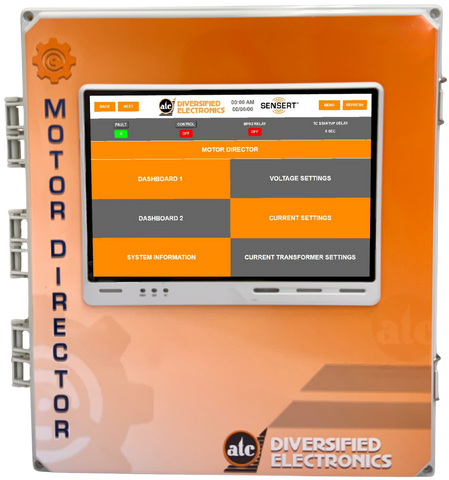
The Motor Director™ Advanced Motor Monitoring and Protection System from ATC Diversified Electronics exemplifies next-generation motor protection. Rather than relying solely on electrical parameters, Motor Director™ tracks vibration alongside voltage, current, power factor, temperature, and rotational speed in real time.
Key capabilities include:
- Real-time vibration monitoring, enabling detection of mechanical anomalies before failure.
- Trend logging and customizable alerts, so technicians are notified the moment parameters deviate from normal.
- Remote visibility and SCADA integration through RS-485, Ethernet TCPIP API and optional wireless sensors.
- Machine Learning AI for predictive insights that differentiate normal variation from actionable trends (Future Development).
This combination empowers maintenance teams to transition from reactive troubleshooting to proactive maintenance planning, reducing unplanned downtime, lowering long-term repair costs, and maximizing motor availability.
Benefits of Smart Vibration Monitoring
- Reduced Unplanned Downtime: By identifying vibration trends that indicate wear or imbalance, operators can intervene before catastrophic failure, eliminating costly unplanned downtime.
- Lower Maintenance Costs: Trend-based alerts allow maintenance to be scheduled during planned windows, reducing overtime, rush repair costs, and production losses.
- Extended Motor Life: Motors that run with undiagnosed mechanical defects suffer excessive wear and shortened operational life. Early detection preserves bearing integrity, shaft alignment, and other mechanical systems.
- Holistic Machine Health Visibility: Motor Director’s integration of vibration with other condition parameters provides a comprehensive health profile, enabling more accurate diagnosis and root-cause analysis.
Practical Implementation Guidelines
To realize the value of vibration monitoring:
- Baseline Normal Operation: Capture vibration and electrical signatures when motors are operating normally to define reference values.
- Trend Regularly: Collect periodic vibration measurements and compare them over time.
- Set Smart Alerts: Configure alarms based on both absolute limits (severity thresholds) and relative changes from baseline, both are critical.
- Integrate with Maintenance Workflows: Ensure alerts trigger work orders, inspections, and scheduled maintenance before faults escalate.
- Correlate with Other Metrics: Combine vibration data with temperature and electrical indicators for more accurate diagnosis.
Motor Protection Is Essential
Vibration monitoring is no longer optional for critical motors; it is a core component of effective asset management. When combined with advanced protection systems like the ATC Diversified Motor Director™, organizations gain the power to spot early warning signs of mechanical failure, reduce downtime, and optimize maintenance strategies.
By embracing condition-based monitoring, facilities can move from reactive firefighting to strategic engineering keeping motors running longer, more efficiently, and with lower lifecycle costs.
For critical applications across water/wastewater, manufacturing, HVAC systems, energy utilities, and industrial processing, integrated vibration-aware motor protection is now essential, not optional.
Click here to download the PDF version of this article.
Common Questions About Motor Director and Vibration Monitoring
Why is vibration monitoring important for motor reliability?
Vibration monitoring is important because many mechanical motor problems begin with small changes in vibration before a major failure occurs. Tracking vibration trends can help maintenance teams identify early signs of bearing wear, rotor imbalance, misalignment, looseness, and other developing issues before they lead to unplanned downtime.
What motor problems can vibration monitoring help detect?
Vibration monitoring can help detect mechanical issues such as bearing degradation, shaft misalignment, rotor imbalance, looseness, excessive mechanical stress, and abnormal operating behavior. When vibration data is tracked over time, changes from the motor’s normal baseline can indicate that maintenance is needed.
How does Motor Director support vibration monitoring?
Motor Director supports vibration monitoring by tracking vibration data alongside other motor health indicators such as voltage, current, power factor, temperature, and rotational speed. This gives maintenance teams a more complete view of motor condition instead of relying on electrical protection alone.
Why are vibration trends more useful than a single reading?
A single vibration reading only shows motor condition at one moment in time. Vibration trends show how the motor is changing over days, weeks, or months. This helps maintenance teams spot gradual mechanical degradation and investigate changes before they become severe failures.
What is a vibration baseline?
A vibration baseline is a reference point captured when a motor is operating normally. Once that baseline is established, future vibration readings can be compared against it. A noticeable increase from the normal baseline may indicate that a mechanical issue is beginning to develop.
How does vibration monitoring support predictive maintenance?
Vibration monitoring supports predictive maintenance by helping maintenance teams identify early warning signs before failure occurs. Instead of waiting for a motor to trip, fail, or cause production downtime, teams can use vibration trend data to schedule inspections, repairs, or replacements during planned maintenance windows.
What is the difference between traditional motor protection and condition-based monitoring?
Traditional motor protection typically responds to electrical problems such as overload, phase loss, voltage imbalance, or current faults. Condition-based monitoring looks at a wider set of motor health indicators, including vibration, temperature, speed, and electrical behavior, to help identify developing problems before they reach a failure point.
How can vibration data reduce maintenance costs?
Vibration data can reduce maintenance costs by helping teams act before a small mechanical issue becomes a larger repair. Early detection can reduce emergency service, overtime labor, rush replacement costs, secondary equipment damage, and production losses caused by unexpected motor failure.